
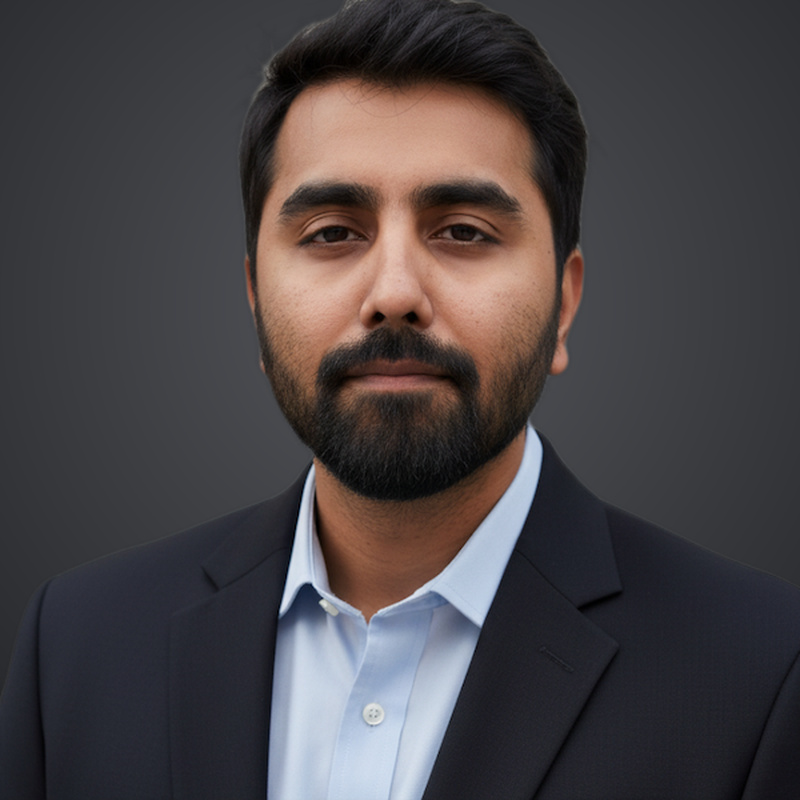
Muhil Venkat
Co-founder &
Chief Delivery Officer


About
Writing software is rarely the hard part. Understanding how your business really works — the exceptions, the workarounds, the rule only one person remembers — is where the work is.
Clevarity started in 2023, out of a frustration our founders had watched play out too many times.
A business with a clear idea. A technology partner who agreed to everything. Eighteen months, a budget gone, and a system nobody could extend — because the questions that mattered were never asked at the start.
The pattern was always the same. Agencies that sold before they understood. Consultants who answered in jargon. Development shops that built exactly what was asked for, even when what was asked for was wrong.
None of that is malice. It's structure. A firm paid by the hour has no reason to tell you that half the plan should be cut.
We built Clevarity to sit on the other side of that. We say what we think before the contract, not after it. We cut features that don't earn their place. And when we're not the right team for something, we say so — which costs us work occasionally, and has never once cost us a client.
Clevarity was founded in Dubai in 2023. The engineering practice behind it has been running since 2013. Our co-founders started their first software practice in Chennai that year. Since then the team has delivered more than 200 projects for over 50 clients. Clevarity is what happens when that bench turns its attention to the Gulf — and to the regulated institutions here that cannot afford a learning curve.
The expensive moment in a project is not the bug. It is the assumption nobody questioned in week one. We ask the uncomfortable questions while they are still cheap to answer, even when it shortens the engagement.
Every feature is a liability someone maintains for years. We would rather ship four things that hold than twelve that need watching. Simplicity is not a style here — it is how a system survives its third year.
We are not measured by what we delivered. We are measured by whether it worked, stayed up, and could be handed to your team without a translator.
We run discovery with the people who actually do the job, write down a domain model everyone agrees on, and then build the rules so your own experts can change them without calling us. A system your team cannot alter is a system you will eventually replace.
Our engineers embed in your tools, your repositories and your delivery rituals, and stay through go-live and support. There is no handover meeting where the knowledge quietly stays with us.
How we work
01
We agree the business outcome before the feature list. Anything that doesn't serve it gets cut here, where cutting is free. This is also where we challenge the brief — the stated problem and the real one are often different.
02
Architecture, stack and risks, on paper. We name what could go wrong and what it would cost before anyone commits. In regulated work, this is also where the compliance posture gets designed in rather than retrofitted.
03
Two-week sprints, each ending in something you can open and use. No invisible progress. If a sprint produces nothing you can click, something has gone wrong and we would rather you knew.
04
Launch, monitor, scale. And a clean handover whenever you want it — documented, with your team able to carry it without us. We would rather be re-hired than depended on.
Clevarity develops its own products, and represents selected products from other developers across the region.
This is not a side venture. It is the reason the engineering holds up.
Running your own software teaches things that client work never will — what breaks at 2am, what costs money in year three, which features nobody opens. Our cloud optimisation product exists because we solved the problem for a client first, saw it was everyone's problem, and built a platform so others could use it at a fraction of the cost.
The same team builds both. The same rigour applies to both.
Co-founder &
Chief Delivery Officer
Co-founder &
Chief Technology Officer

Chief Innovation Officer
We deploy into your cloud accounts and pipelines where they exist, rather than moving you onto ours. Azure, AWS or Google Cloud — we hold no partner tier that decides the answer in advance, so the recommendation follows your data residency obligations, your estate and your cost profile.
We hire rarely and carefully, and we are always open to a conversation. Careers